Noblemens Honey

Our honey is raw, mature and unprocessed

NOBLEMENS Natural Bee Honey is harvested personally from bee farms in the North Indian plains and Himalayan region.

We collect mature honey from fully sealed honeycombs and bottle it raw, without deliberate heat processing. Our focus is on maturity, careful collection, and minimal processing.

About Our Honey

Our Honey Is Raw, Mature and Unprocessed.

Bees collect a dilute sugary solution called nectar and pollen from flowers. Nectar contains 60 to 80% moisture.

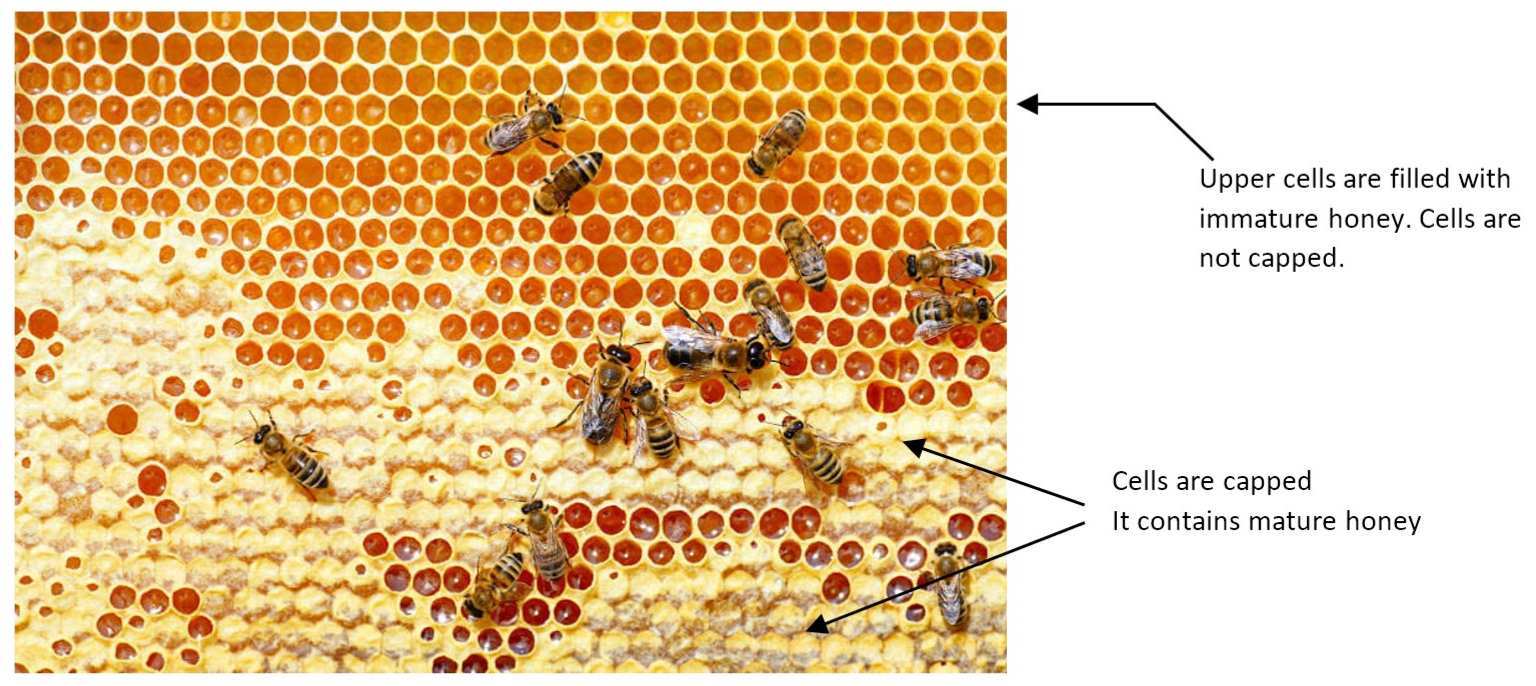
If you look at the honeycomb, you will see that some cells are partially filled with liquid. This visible liquid is immature honey and not the final product. It contains a higher percentage of water, hence shelf life is not long. Yeast and bacteria present in the surrounding environment will soon spoil it.

Worker bees consume nectar and produce honey in several days using complex biological and physical processes. Final mature honey contains about 16 to 20% moisture.

Bees store mature honey in hexagonal cells and cover the opening with a wax cap. A fully sealed honeycomb contains ripe and mature honey. This indeed is the raw honey that we collect.

We harvest this from bee hives always in personal presence and bottle it raw.

It is wholesome with all natural ingredients, enzymes and hormones intact.

Partially capped honeycomb showing uncapped and capped cells
A partially capped honeycomb: uncapped cells contain immature honey, while capped cells contain mature honey.
What Is Processed Honey

Why Is Much Commercial Honey Processed?

A single commercial bee farm maintains from a few dozen to several hundred bee boxes. Physically checking each box and finding out if all the cells are capped is a labour-intensive and time-consuming task.

Short flowering seasons and limited manpower do not allow such a proposition. Hence, bee keepers do not wait for honeycombs to be fully capped.

Harvesting is done at varying degrees of maturity. Some honeycombs may be 100% sealed, while some may be roughly 60 to 80% sealed. They collect all the honeycombs from all the boxes in a single go and extract the honey.

Honey extracted in this way can be high in moisture content and not fully ripe. A shortcut solution adopted commercially is to heat or boil it to get rid of excess moisture.

In addition, fine filtration may be done to remove pollen, a beneficial ingredient. Pollen can act as a nucleus for crystallisation, hence some commercial honey suppliers remove it by filtration.

Processed Honey

Heat Destroys Some of Honey's Delicate Components.

It is a general natural phenomenon that high temperature degrades delicate ingredients.

Processing involves heating to 55 to 80°C. We believe that processed honey loses some of its health benefits.

Heat exposure can affect delicate components of honey. This is why we choose not to deliberately heat our honey as part of processing.

Our approach is simple: start with mature honey and avoid unnecessary heat processing.

Why We Avoid Heat

Honey contains naturally occurring compounds that contribute to its composition and character.

High temperatures can affect delicate components depending on the temperature and duration of exposure.

We therefore avoid deliberate heat processing and preserve the honey as close as possible to its naturally collected form.

How We Avoid Processing

We Personally Remain Present From Collection to Extraction.

We personally visit bee farms and remain present from picking up fully sealed combs till honey extraction.

With prior agreement and constant personal presence, collection of raw and mature honey becomes possible.

We look for fully sealed honeycombs rather than relying on processing to compensate for honey that was collected before maturity.

Our honey is harvested personally from the North Indian plains and Himalayan region and bottled raw.

We prefer to wait for mature honey rather than use processing to compensate for harvesting it before maturity.

Benefits of Honey

Naturally Rich in Compounds Studied for Their Potential Benefits.

Honey contains naturally occurring phenolic acids, flavonoids, enzymes and oligosaccharides. Research has examined several possible effects of honey consumption. These findings relate to honey generally and should not be taken as proof of a specific health effect from NOBLEMENS honey.

Antioxidant Activity

Honey contains phenolic acids and flavonoids, such as chrysin, luteolin and kaempferol, that are associated with antioxidant activity. These compounds may help neutralize harmful free radicals and reduce cellular oxidative stress.

Research: Sharaf El-Din et al., 2025, Journal of Traditional Chinese Medical Sciences.

Cardiovascular & Metabolic Support

Human and animal trials suggest that natural honey intake may help improve lipid profiles by reducing total cholesterol, low-density lipoprotein and triglycerides, while potentially elevating high-density lipoprotein.

Research: Palma-Morales, Huertas & Rodríguez-Pérez, 2023, Nutrients, 15(13), 3056.

Cough Suppression

Research indicates that honey can effectively soothe and suppress nocturnal coughing in children over one year of age, often performing comparably to over-the-counter cough suppressants.

Research: Oduwole O, Udoh EE, Oyo-Ita A, Meremikwu MM. Honey for acute cough in children. Cochrane Database of Systematic Reviews, 2018.

Gastrointestinal & Prebiotic Support

Oligosaccharides present in honey act as prebiotics, promoting the growth of beneficial gut microbiota, while secondary studies point to mild anti-inflammatory effects in the digestive tract.

Research: Schell KR, Fernandes KE, Shanahan ER, et al., 2022, Frontiers in Nutrition, 9, 957932.

Research note: These studies examine honey as a food in general. They do not establish that NOBLEMENS honey treats, prevents, or cures any disease. NOBLEMENS does not present honey as a substitute for medical treatment.

Farm Honey

Is Farm Honey Inferior to Wild Honey?

No, it is not inferior.

Bees collect nectar and pollen from flowers. Whether it is wild bee or bees kept in farmer's boxes, the honey-making process is the same.

It may be noted that concentrated nectar is not honey. Honey is a liquid generated by worker bees within their bodies. Nectar and pollen are only raw materials.

A Personal Observation

The owner of this company personally witnessed a phenomenon hence hitherto unknown to many bee experts.

In 1997 or 1998, he and his family resided in a high-rise building in Anushaktinagar, Trombay. A swarm of Apis dorsata (giant bee, or rock bee) settled outside his 12th-floor kitchen window and started a colony.

He slightly opened the glass panel and placed sugar syrup using a stick. It was observed that bees were not much interested in it, however a section of bees accepted it.

Later he saw visually from a close proximity of about 25 to 30 inches that bees repeatedly regurgitated it till a small droplet of about 1 to 2 mm diameter appeared in their mouth, then after a few seconds drank it back.

Bees did it repeatedly while quietly resting on the hive. It is believed that one reason for doing this is to evaporate excess water.

This also confirms the company's observation that formation of honey takes place inside the body of bees.

Jungle Honey

Jungle Honey: Collection and Extraction Matter.

Wild honey itself isn't the problem — it is the time of collection and method of extraction that is objectionable.

Wild honeycombs are simply squeezed by hand in some traditional collection methods. This can introduce impurities and hygiene risks.

Another concern is that harvesting is done in a single visit to the jungle, with combs collected irrespective of maturity.

These traditional methods can turn a premium natural resource into a second-grade product.

For NOBLEMENS, the important questions are simple: Was the honey mature when it was collected? How was it extracted? How was it handled afterwards?

See the video of Sundarbans, West Bengal, showing how honey is collected under constant threat of wild tiger.

How to Take Honey

Simple Ways to Take Honey.

Honey can be used as part of everyday food and drink. The following suggestions are based on the traditional use described for this product and are not medical instructions.

Daily Use

For maximum benefit: We recommend taking 1 to 2 level teaspoons of honey mixed with a cup of normal water (not warm) and drinking it on a relatively empty stomach. Make it a regular daily habit.

For Cough

Take 1 to 2 level teaspoons of honey without water. Honey should not be given to children below 1 year of age.

For Instant Energy

Take 2 level teaspoons of honey with or without water at any time.

With Milk

For physical and mental energy boosting, mix 2 level teaspoons of honey in a cup of milk. Drink it for both short-term and long-term benefit.

With Hot Tea as a Sweetener

Not recommended. Heat degrades some of the ingredients.

Natural Bee Honey

Raw, Mature Honey From NOBLEMENS.

Harvested personally from the North Indian plains and Himalayan region. Collected from mature honeycombs and bottled raw without deliberate heat processing.

Research References

Sources & Further Reading

1. Honey and antioxidant compounds

Sharaf El-Din MG, Farrag AF, Wu L, et al. “Health benefits of honey: A critical review on the homology of medicine and food in traditional and modern contexts.” Journal of Traditional Chinese Medical Sciences. 2025;12(2):147–164. DOI: 10.1016/j.jtcms.2025.03.015.

2. Honey and human health

Palma-Morales M, Huertas JR, Rodríguez-Pérez C. “A Comprehensive Review of the Effect of Honey on Human Health.” Nutrients. 2023;15(13):3056. DOI: 10.3390/nu15133056.

3. Honey and acute cough in children

Oduwole O, Udoh EE, Oyo-Ita A, Meremikwu MM. “Honey for acute cough in children.” Cochrane Database of Systematic Reviews. 2018; Issue 4. CD007094. DOI: 10.1002/14651858.CD007094.pub5.

4. Honey and prebiotic potential

Schell KR, Fernandes KE, Shanahan ER, et al. “The Potential of Honey as a Prebiotic Food to Re-engineer the Gut Microbiome Toward a Healthy State.” Frontiers in Nutrition. 2022;9:957932. DOI: 10.3389/fnut.2022.957932.

5. Honey quality and processing

Codex Alimentarius, Standard for Honey (CXS 12-1981). The standard states that honey should not be heated or processed to an extent that changes its essential composition or impairs its quality.

Scientific references provide general information about honey and its composition or potential effects. They are not clinical claims about NOBLEMENS Natural Bee Honey and should not be interpreted as medical advice.

Explore Noblemens

Discover More From Our Premium Natural Collection.

Beyond our natural honey, Noblemens offers a growing collection of products rooted in authenticity, craftsmanship, and thoughtful living.

Explore our naturally crafted perfumes, vinegars, and other carefully developed offerings designed for people who value purity, quality, and refined simplicity.